Got a DOT sidewalk violation notice? JBS clears it end to end: we pull the permit, break out the cited flags, repour to NYC DOT spec with a broom finish, and file the dismissal — across Queens, Brooklyn and all five boroughs. You have at least 75 days; most jobs take under a week.
A NYC sidewalk violation is a notice from the Department of Transportation stating that the sidewalk in front of your property has defects — such as trip hazards, collapsed or cracked flags, improper slope, or tree-root damage — that you, the property owner, are legally responsible for repairing under Administrative Code §19-152. It is not a fine, but it attaches to your property record until the sidewalk is repaired to DOT specification and the violation is dismissed.
Violations commonly appear after a DOT inspection triggered by a 311 complaint, a City survey, or a pending property sale. Title companies flag open sidewalk violations, so many owners discover them at the worst possible time — mid-closing. JBS handles rush timelines for exactly that reason.
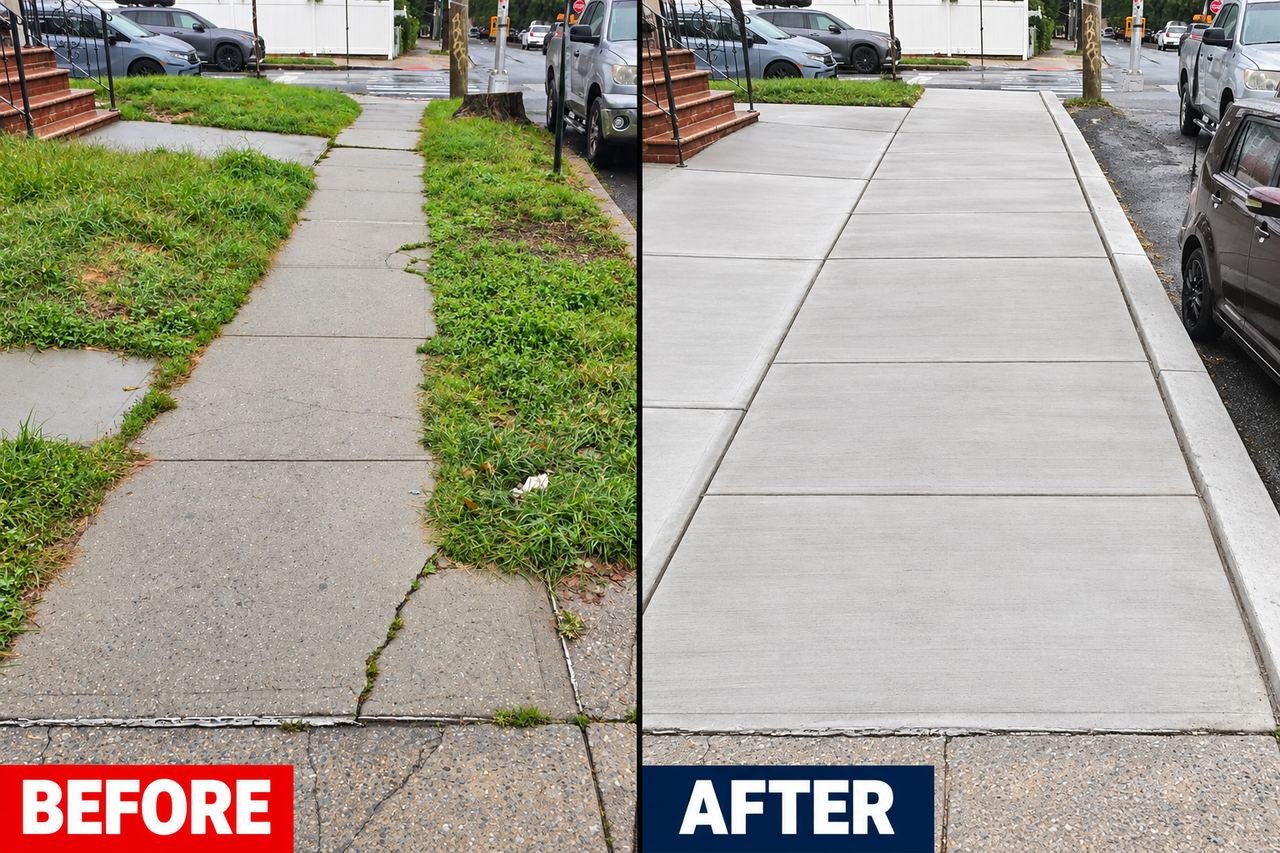
A Notice of Sidewalk Violation carries no fine. It is an order to repair, filed with the County Clerk against the property — which is why it surfaces at closings and refinances.
Counted from the certified-mail receipt or posting date (NYC Admin. Code § 19-152). Only 10 days where DOT declares an immediate danger. A permit does not extend it.
Covers up to 300 linear feet at one property, including the dismissal inspection. Repairs over $200 need a DCWP-licensed, DOT-registered contractor to pull it.
A vertical difference of ½" or more between flags is a trip hazard — the defect cited on 69% of open NYC violations.
Expansion joints at least every 20 feet, at property lines and at the curb; concrete 7" thick at driveway aprons and 4" elsewhere.
The owner, under Admin. Code § 7-210 — except owner-occupied one- to three-family homes used only as residences. They are exempt from liability, not from the duty to repair.
As of 9 September 2026, NYC Open Data lists 133,541 open, undismissed sidewalk violations citywide; 92,572 of them cite a trip hazard. Read the full NYC Sidewalk Violation Owner's Guide for the timeline, exemptions and dismissal steps.
As licensed sidewalk contractors in New York City, our crews and trucks run out of 91-01 120th Street in Richmond Hill, so Queens sidewalk jobs — Richmond Hill, Jamaica, Ozone Park, Forest Hills, Flushing and beyond — get the fastest scheduling, with Brooklyn close behind. We clear violations in the Bronx, Manhattan and Staten Island on the same DOT process. Selling soon? Tell us your closing date and we schedule around it.
| Cited defect | Typical cause | Our fix |
|---|---|---|
| Trip hazard | Settled or heaved flag edge ½" or more | Full-flag replacement, doweled to adjacent flags |
| Collapsed / broken flag | Tree roots, vehicle loading, failed subgrade | Break-out, subgrade compaction, new 4,000 PSI pour |
| Tree-root damage | Street tree lifting flags | Root-prune per Parks rules, reinforced repour or flexible detail |
| Patchwork / non-compliant repair | Asphalt cold-patch or thin overlays | Remove patch, repour full flags to spec |
| Improper slope | Settlement toward or away from curb | Re-form and repour to DOT cross-slope |
| Hardware / grating defects | Sunken utility covers, vault lids | Reset hardware flush, repour surround |
Violations are the emergency — but most of our sidewalk work is planned: new sidewalk installation for new builds and curb-cut changes, full sidewalk replacement when patching stops making sense, sidewalk restoration on landmarked blocks (including in-kind bluestone), and concrete and cement sidewalk repair for cracked, sunken, or root-heaved flags before DOT ever gets involved. We also pour everything around the sidewalk: concrete curbs, driveway aprons, tree pit rebuilds, ADA ramps, and sidewalk vault repairs — all to DOT spec, under our own permits.
A Notice of Sidewalk Violation is an order from the NYC Department of Transportation to repair defects in the sidewalk next to your property, such as trip hazards, broken or collapsed flags, or improper slope. It is issued under NYC Administrative Code § 19-152. It carries no fine, but it is filed with the County Clerk against the property, where it can complicate a sale or refinance.
At least 75 days, counted from the certified-mail receipt date or the posting date. DOT can shorten that to 10 days only where it declares an immediate danger. Getting a permit does not extend the deadline. After it passes, the City can do the repair itself and bill the owner.
$70 for up to 300 linear feet at one property. That fee covers both the administrative cost and the dismissal inspection. JBS files the permit for you.
Repairs over $200 must be done by a contractor licensed by the NYC Department of Consumer and Worker Protection (DCWP) who is also registered with NYC DOT, because only a registered contractor can pull the sidewalk permit.
Under NYC Administrative Code § 7-210 the property owner is liable for sidewalk injuries, except for one-, two- or three-family homes that are at least partly owner-occupied and used only as residences. That exemption covers liability only: those owners still have to repair the sidewalk when cited.
For one- to three-family properties, the City no longer issues sidewalk violations for damage caused solely by City street trees, and outstanding liens of that type have been canceled. If your notice cites other defects as well, those still need repair. We check the notice and document tree-root damage at the assessment.
The most common cited defect is a trip hazard: a vertical difference of ½ inch or more between flags. DOT specification also requires expansion joints at least every 20 linear feet, at property lines and where the curb meets the sidewalk, and concrete 7 inches thick at driveway aprons and 4 inches elsewhere.
After the repair, request a Sidewalk Violation Dismissal Inspection through NYC311, with the permit number, property address, block and lot, violation number, and the owner's email and phone ready. DOT inspects the work; when it passes, the violation is dismissed and DOT notifies the County Clerk. JBS files the request for you and makes sure the whole sidewalk is visible for the inspector.
Most residential sidewalk violations are repaired in under a week once work starts: permit, saw-cut and break-out, forming, the DOT-spec pour and cure. Weather and permit turnaround are the main variables.
Cost depends on how many flags the DOT diagram marks, tree roots, curb work and access; a typical residential sidewalk repair runs roughly $1,000–$4,000, and larger or commercial jobs run higher. After a free assessment JBS gives a flat, itemized price that includes the permit, demolition, disposal, the pour and the dismissal request.
Yes. Concrete curbs, steel-faced curbs and driveway aprons are DOT-permitted work we pour to spec alongside the sidewalk flags.
The owner of the property next to the sidewalk is responsible for repairing it when DOT issues a Notice of Sidewalk Violation (NYC Administrative Code § 19-152), and for sidewalk injury liability under § 7-210, except owner-occupied one- to three-family homes used only as residences. For one- to three-family properties, the City no longer cites damage caused solely by City street trees.
Request the status or a copy of a sidewalk violation through NYC311 (311 article KA-01506), by phone or online. For an NYC sidewalk violation search by property, open violations are also published in the NYC Open Data Sidewalk Management Database. Send JBS the violation number or address and we will check it for you at the free assessment.
If a sidewalk is not repaired within 75 days of a Notice of Sidewalk Violation, NYC DOT may repair it through a City contractor and bill the owner through the Department of Finance, priced by the square footage on the inspection report. Payment plans are available, the Expedited Sidewalk Repair Program is currently paused, and the City does not repair sidewalks over vaults. Many owners hire a private contractor to control the timing, finish and cost.
A sidewalk violation is filed with the County Clerk and stays on record until the repair passes the DOT dismissal inspection. If the City did the repair, the owner has 90 days to pay the Department of Finance bill; after that interest accrues and a monetary lien is placed on the property. Repairing the sidewalk privately and getting the violation dismissed keeps it off the record; DOT is also cancelling liens for one- to three-family properties where damage was caused solely by City street trees.
Free estimates within 48 hours for concrete and contracting. Same-day dumpster delivery when you call before noon, Monday–Saturday.